Blogs Blogs

Recently published: TSKB 5 – Die koptischen Miniaturkodizes aus spätantiker Zeit (Coptic Miniature Codices from Late Antiquity)

It is not only the content but also the format of late antique manuscripts that can reveal interesting facts about the use and functions of biblical and non-biblical literature in Roman-Byzantine Egypt. Recently, there has been increased research on particularly small-format codices, as demonstrated by Michael J. Kruger’s monograph “Miniature Codices in Early Christianity,” published in 2025. In his work, Kruger primarily examines Greek manuscripts of the smallest format containing Christian texts. However, this type of codex was also widespread in Egypt among Coptic manuscripts. This became clear several years ago when Alin Suciu published a list of Coptic miniature codices. 

Building on this and other studies, a monograph has recently been published, which, in appr. 600 pages, for the first time explicitly examines Coptic miniature codices from the late antique period. Jan-Malte Ziegenbein’s work defines and catalogues a corpus of over 140 Coptic manuscripts of a particularly small format that can be dated to the 4th–8th centuries. Based on content, material, palaeographic, and linguistic-orthographic characteristics, conclusions are also drawn regarding the dating, origin, and function of the codices.

The work originated as a PhD thesis at the University of Göttingen, supervised by Prof. Heike Behlmer and Dr Frank Feder. It has now appeared as the fifth volume of the series Texte und Studien zur Koptischen Bibel / Texts and Studies on the Coptic Bible (TSKB) distributed by the Harrassowitz Verlag, Wiesbaden.


Psalter & Gospel of Matthew. Dublin, Chester Beatty Library, Copt. Ms. 815, fol. 152r. Approx. 10.5 x 8.5 cm (h x w), 6th–7th century. Source: https://viewer.cbl.ie/viewer/image/Cpt_815/305/.


A key to defining a corpus of Coptic miniature codices: In the colophon of Copt. Ms. 815 at the Chester Beatty Library in Dublin, the manuscript itself is explicitly referred to as ⲡⲉⲓ̈ⲕⲟⲩ<ⲓ> ⲛ̄ϫⲱⲱⲙⲉ “this small book”.


Curatorial Position in Egyptology at the Ägyptische Museum und Papyrussammlung in Berlin

A new position has opened at the Egyptian Museum and Papyrus Collection in Berlin, which possesses one of the largest collections of papyri in the world.

The museum is currently seeking a wissenschaftliche*r Mitarbeiter*in / Kurator*in in the field of Egyptology. The position offers the chance to work closely with one of the most significant collections of Egyptian antiquities and papyri.

The position combines scholarly research with curatorial responsibilities, including collection-based work, exhibition development, and contribution to broader institutional projects. It is particularly well-suited for candidates interested in bridging academic Egyptology with museum practice and public engagement.

Applicants are expected to have a strong academic background in Egyptology, along with relevant research and, ideally, curatorial or collection-related experience.

Further information and application submission can be found here.

New Position in Egyptology & Coptology at Georg-August-Universität Göttingen

Colleagues in Egyptology and Coptology may be interested in a newly advertised two-year position at the Seminar für Ägyptologie und Koptologie in Göttingen.

A full-time position (wissenschaftliche*r Mitarbeiter*in, E13 TV-L) is now open, starting at the earliest possible date. The appointment is limited to two years and is designed to support advanced research, particularly the completion of a second major project (e.g. a habilitation).

The role combines research and teaching. The successful candidate will contribute to courses in Egyptian and Coptic language, literature, and the cultural history of Egypt from the Pharaonic period through Late Antiquity, alongside participation in supervision, examinations, and departmental activities.

Applicants are expected to hold a PhD in Egyptology (or a closely related field), demonstrate strong publication and teaching experience, and command all stages of the Egyptian language. Familiarity with digital research is also required.

Application deadline: 12 May 2026

Further details and application instructions are available here.

Coptic Manuscript Fragments at Trinity College, Cambridge

The manuscript collections of Trinity College, Cambridge, are famous for their treasures. However, less well known is a relatively small but intriguing group of fragmentary Egyptian papyri in a variety of languages. These materials, now fully digitised by the Wren Library, are accessible online.

The papyri are stored in boxes labelled according to language: “Greek,” “Coptic,” and “Arabic.” However, even a cursory inspection shows that these divisions should be treated as approximate: for example, fragments classified as “Coptic” contain Greek material, and vice versa. Furthermore, the collection includes the so-called “Murray Papyri,” which were donated by A. G. W. Murray (1884–1919) to the Library. These also appear to include additional Coptic pieces.

The bulk of the collection consists of documentary texts on papyrus. Yet scattered among them are occasional literary texts on papyrus, parchment, and paper. Until now, only the Arabic material has been preliminarily inventoried by Petra Sijpesteijn. In this post, I would like to draw attention to the small group of Coptic biblical fragments in this collection.

Biblical Fragments from the Pauline Corpus

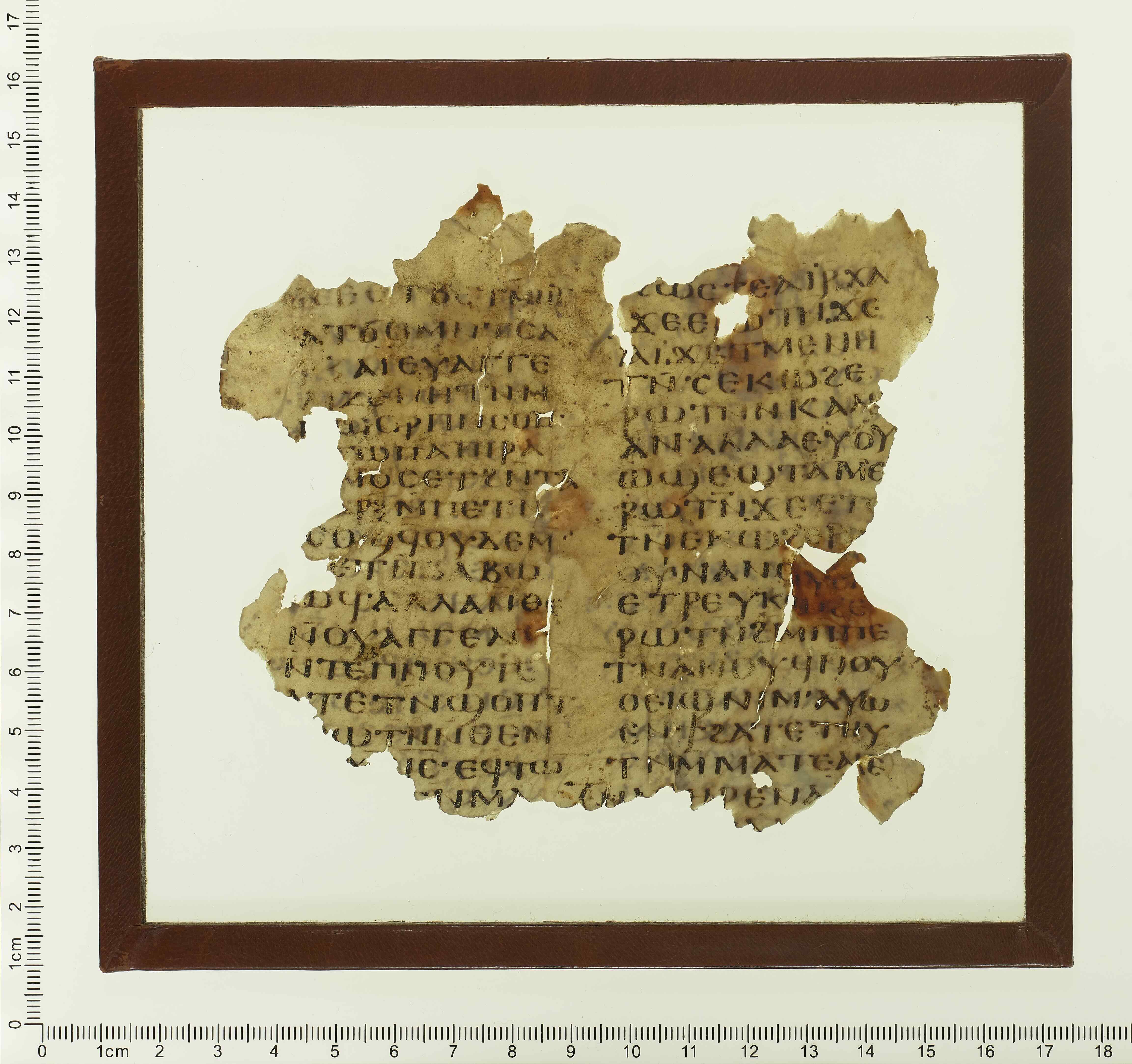
One of the most striking parchment pieces is the last, unnumbered Murray fragment, which contains a portion from the Epistle to the Galatians (4:13–26) in Sahidic. Its script suggests a date as early as the sixth century, making it a valuable witness for the transmission of the Pauline corpus in this dialect.
A Sahidic paper fragment from the same group, Murray 5, preserves First Epistle to Timothy 4:12–5:4. The fragment is paginated 158/159 (even/odd!), which suggests that it once belonged to a substantial codex. On palaeographical grounds, it is unlikely to predate the thirteenth century CE, and thus belongs to the final phase of Sahidic as a literary language.
A Gospel Fragment

Among the papyri inventoried as Coptic, perhaps the most noteworthy is “Coptic 17,” which derives from a papyrus codex of the Gospel of John. The fragment is written in a handsome Alexandrian uncial, pointing to a date in the seventh or eighth century.
Other Interesting Material

Among the fragments grouped as “Coptic 15,” one item (no. 7) appears to be liturgical. By contrast, item 6 from the same frame is clearly documentary, probably an account in Sahidic. The verso was subsequently reused to accommodate a private letter in Arabic. The importance of this document lies in the fact that the Sahidic text preserves a precise date: the month of Mesore, year 661 of the Era of the Martyrs, corresponding to July/August 945 CE.
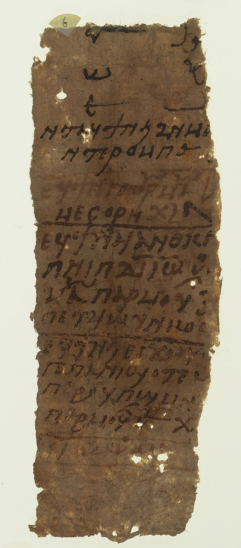
Assuming that this is indeed the date when the Coptic text was written, the document in question is particularly noteworthy, as it may represent one of the earliest securely dated Coptic paper manuscripts. The transition from papyrus and parchment to paper in medieval Egypt remains poorly understood. Although paper had already come into widespread use in the Islamic caliphate, Coptic scribes appear, at least into the tenth century, to have reserved paper primarily for more ephemeral or utilitarian texts such as accounts and letters. By contrast, parchment continued to be preferred for biblical, liturgical, and other literary manuscripts. In this context, parchment functioned not only as a more durable writing surface, but also as a material marker of authority and prestige.

Ink Analysis at the Fondation Martin Bodmer

In July of this year, I was able to travel to Geneva to work with the Bodmer Collection in Cologny.  The object of the trip was a collaboration with Ira Rabin from the BAM (Bundesanstalt für Materialforschung und -prüfung) to do ink analysis on manuscripts from the Bodmer Collection.  I have previously traveled to the archive to work on a project that is in progress, and I was particularly interested in the ink analysis of Papyrus Bodmer 44, a Bohairic translation of the Book of Daniel.  

Research was carried out using an XRF (X-ray fluorescence) spectrometer to analyze the chemical composition of Bodmer manuscripts’ inks.  Specifically, the radiation is sent through the material to be analyzed and the various elements in the ink, e.g. copper, iron, nickel, etc., produce various X-rays, which can then be recorded by the XRF spectrometer. 

Analysis could only be carried out on areas with ink on one side.  Thus, careful preparation was required to identify potential areas that also measured at least Ø 1 mm and had ink in relatively good condition.  Images of the desired areas were also taken using Dino-Lite to produce NL (normal light), UV (ultra-violet), and IR (infrared) photographs of the areas being analyzed.  This provides additional information, and can show when carbon or plant-based inks were being used.

In addition to PB44, we were able to analyze the ink from many different Bodmer manuscripts.  This will be useful not only in understanding the relationship of a text in a singular manuscript, but to also get a better understanding of the Bodmer Papyri as a whole.

The complete analysis of our findings is still in progress, however, I look forward to the results and implementing them in further study on the Bodmer Collection.


CoptOT Blog Entries