Blogs Blogs

A Visit to the Lucca Archive

In June of last year, our colleague, Alin Suciu brought a source of new Coptic papyrus fragments to the attention of our team.  These fragments, under the shelfmark Biblioteca Manoscritti 305 are housed in the Archivio di Stato di Lucca in Italy.

Of particular interest to me was a fairly large fragment from the book of Daniel, and it was with that main intent that I arranged a visit to the archive.

I visited the archive at the end of January and was able to consult the Daniel fragment.  An autopsy of the fragment enabled me to confirm Alin Suciu's identification of the fragment as coming from Daniel chapter 1.  This fragment forms an almost complete page from a codex.  This was a single column papyrus codex which would have measured not much more than 18 x 14.1 cm.  The margin is visible on one side of the page.  Specifically, the recto contains Dan 1:5b-8a and the verso 1:8b-10.

This attestation is of great help, as the only other witnesses of these verses in Sahidic are in sa 2050 and an ostracon (Var 18), which I am currently working on.  This is especially helpful with verse 7, which is entirely in a lacuna in sa 2050 except for the first word ⲁϥϯ.  Sa 2050 is housed in the Bibliothèque nationale in Paris and is only the bottom portion of a page.  At some point, it is likely there was more to the fragment, as Maspero has a great deal more text recorded for Daniel 1:7 in his Fragments de Manuscrits Coptes-Thébains[1]. With the addition of the text from Lucca, one can almost completely reconstruct this verse.  In addition, a second attestation to these verses serves to establish a complete reading for these verses - something that is exceedingly difficult with the biblical Daniel corpus in Sahidic, which is so fragmentary that many sections are not attested at all, or are attested only by a singular manuscript.

There were many other fragments that I was able to examine. I was able to confirm that despite being under one accession number, these fragments were written by multiple hands and come from multiple different manuscripts.  Some fragments are unimodular, while others are bimodular.   In addition, the size of the letters varied significantly between some fragments, and some were written with a finer pen than others.  The most likely explanation for the variation among these fragments is that they come from multiple manuscripts.

There were many other fragments that I wished to more closely analyze, but was unable to due to time constraints.  Time was short, but I hope in the future another trip can be made to complete the initial work on these fragments.

I look forward to continuing to work with this archive in the future and hope that a closer analysis of the many fragments will yield more Old Testament attestations.


[1] Maspero, G., “Fragments de manuscrits coptes-thébains provenant de la bibliothèque du Deir Amba- Shenoudah,” Mémoires publiés par les membres de la Mission Archéologique Française au Caire 6 (1892) 268.

Autopsying Manuscripts at the BnF in Paris, 18–23 November 2024

The research visit Diliana Atanassova and myself made to the BnF last week proved fruitful both in terms of autopsying original manuscripts and in terms of using different settings to decipher heavily damaged portions of texts. Diliana examined Sahidic liturgical fragments (ca. 10-11th c.) and Sahidic Old Testament leaves (from the 7th, 7th–8th and 11th c.). For my part, I examined Sahidic liturgical fragments and leaves (from the 10th to the 14th c.), an Arabic Holy Week lectionary (1312 AD) and the Latin Codex Colbertinus (12th c.).
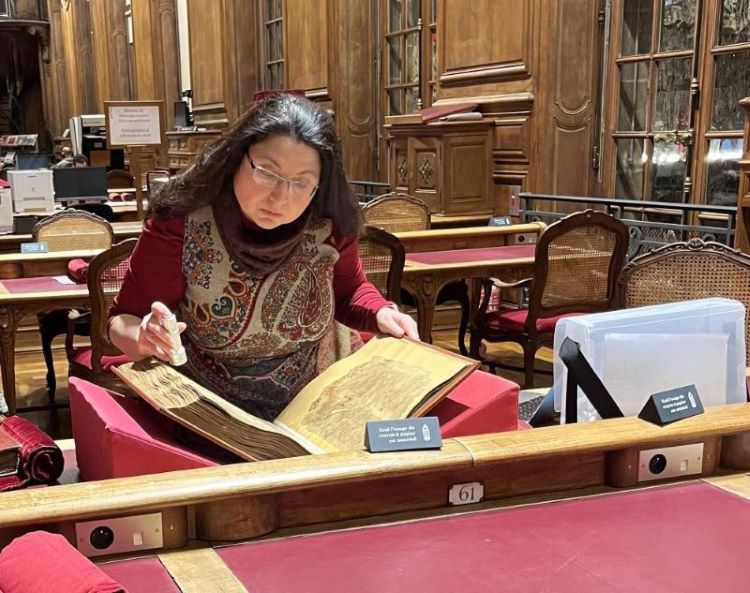
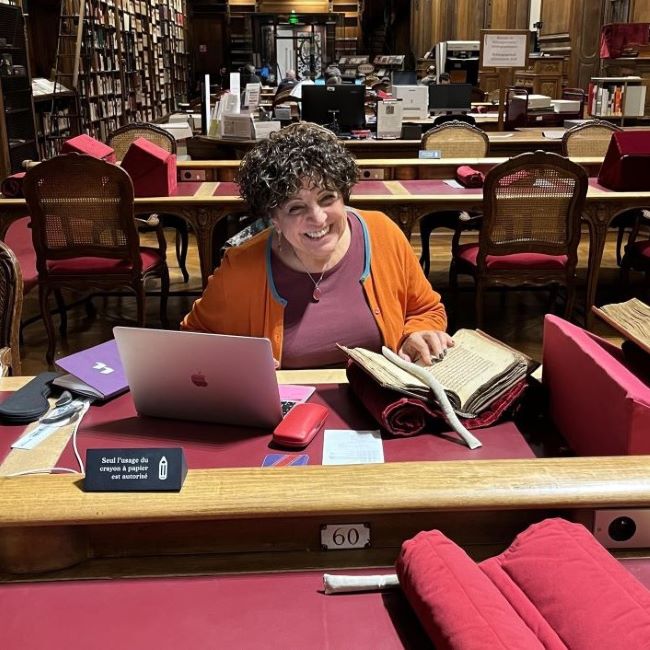
   

In this brief blog post, I shall restrict my account to our experience with the UV light.

In recent times, the use of colour photography with enhanced resolution has often rendered the autopsy of the original material superfluous. However, this was not the case with the BnF images of the leaves and fragments under consideration, where parts of the texts were illegible. Our experience at the BnF last week showed that there are at least four different methods that can be employed in such cases.

The first is to work with the source material in the BnF's large dedicated reading room, which is lit by natural and artificial light. This can prove effective in enabling the deciphering of letters that have not undergone significant deterioration.

The second method is to examine the original in the above-mentioned reading room, while using UV light. One hand is used to cast a shadow on the text, while the other hand points the UV light at the text. This method proved effective in rendering some of the more challenging letters legible; however, there were places in which the ink was washed out and nothing could be seen while we were in the reading room.

It was evident that the only viable solution was to utilise a darkroom. We were very fortunate that Dr Vanessa Desclaux, the Curator of the manuscripts of Ancient Egypt and the Christian Near East, had reserved the Salon Rothschild for us and freed up time in her schedule to allow us to use this dimmable environment in her presence. There, we used the third method, which involved focusing on the illegible letters under UV light in total darkness. This proved an effective approach in many instances and enabled us to recognise the traces of the letters.

The fourth method was discovered by chance. A column of text had been so severely washed out that the ultraviolet light in the darkroom, shining on the missing text from above, had no effect. However, in an attempt to resolve this issue, Diliana discovered that the invisible text could be made visible by holding the ultraviolet light at a certain angle behind the page.

Our stay was evidently too short and we will definitely need to visit the BnF again. To conclude, we would like to express our sincere thanks to Dr Desclaux and to the competent and helpful staff of the Department of Manuscripts of the BnF.*

* The photos are published with the kind permission of the BnF. 


French-speaking Coptologists take interest in manuscripts of the Pauline Epistles

On 17 October 2024, I had the pleasure and privilege of delivering the opening lecture of the monthly seminar “Manuscrits et textes coptes”, held in Paris (but accessible via Zoom) and co-organized by the Institut de Recherche et d’Histoire des Textes (a research unit of the French CNRS), the Association Francophone de Coptologie, and the Institut Protestant de Théologie. Being at the end of my postdoctoral project at the Göttingen Academy of Sciences and Humanities in Lower Saxony, I found it fit to present an overview of the said project. My lecture was titled: “Les manuscrits coptes des épîtres pauliniennes”.

Most conferences limit the speaking time from 20 to 30 minutes per speaker, questions included (excluding plenary lectures). By contrast, the session at which I spoke could last up to 2 hours all included. Thus, I was able to delve into many issues including digital tools (including the renowned Virtual Manuscript Room), codicology, palaeography, and provenance. Additionally, I regularly asked the participants to intervene and share their insights.

The lecture comprised five parts. To begin with, I introduced the GALaCSy project, the team members, the project’s goals, and the digital tools we used — tools whose possibilities are not always known to Coptologists. Thereafter, I gave an overview of Sahidic manuscripts of the Pauline Epistles. Then, I did likewise with manuscripts of the Pauline Epistles in other dialects, more precisely, in Lycopolitan and Mesokemic. Nathalie Bosson kindly intervened to present the findings of her doctoral dissertation on the Mesokemic manuscript mae 4. After that, I addressed the Sahidic manuscript sa 491, a fragmentary but potentially very ancient witness of the Pauline epistles. Since sa 491 has no known provenance, this was an opportunity to discuss whether, more generally, scholars should study and publish manuscripts of uncertain provenance and/or archaeological provenience. In the last minutes of the allotted time, I provided a brief assessment of the project’s results.

I warmly thank Anne Boud’hors, Korshi Dosoo, Catherine Louis, Laurent Pinchard, and Anna van der Kerchove for making this event possible. The next session (on 28 November 2024) will be conducted by Loreleï Vanderheyden and will focus on the theme “Textes en copte d’Aphrodité à Heidelberg? Identification et édition de nouveaux fragments”.

Peter Nagel (3rd April 1938 – 1st August 2024)

It was with deep sadness and sorrow that we received the terrible news that Peter Nagel, the doyen of Coptic Septuagint Studies and most important supporter of our project, passed away last Thursday, August 1, 2024. As Professor of Christian Near Eastern Studies in Halle (Saale) and Bonn he taught and influenced several generations of scholars not only in Coptic Studies. It is difficult to list the many achievements and merits of Peter Nagel as an outstanding scholar of the 'old school'. Since this will be done in many places, we will concentrate here on his significant contributions to the study and edition of the Coptic Old Testament. It was Peter Nagel who launched and directed the first systematic attempt at a complete reconstruction and edition of the Coptic Old Testament, or the 'Coptic Septuagint', at the Seminar Christlicher Orient and Byzanz of the Martin–Luther–University Halle-Wittenberg in the late 1970s. After his move to the University of Bonn the project Koptische Septuaginta continued its work in Halle from 1994–2000 under his advice and direction. When it was already confirmed that our project would be funded at the Göttingen Academy of Sciences and Humanities as apart of the long-term research funding program of the German Academies we celebrated Peter Nagel's 75th birthday and thanked him for his support and guidance with an international symposium at the Coptic Monastery in Höxter-Brenkhausen in April 2013. We were also able to honor Peter Nagel with a Festschrift celebrating his 80th birthday. This volume very fittingly was the first to appear in our new monograph series Texts and Studies on the Coptic Bible. It is difficult to describe in a few lines how much our digital edition has profited from the numerous and diverse analogue materials he has made available to us. It is, therefore, only appropriate that we have dedicated a special section in our digital resources menu to Peter Nagel's contributions to the study of the Coptic Bible, including his most recent editions.

Like Coptic Studies in general, the field of Coptic Biblical Studies in particular will for ever be connected with the name of Peter Nagel: ⲡⲉϥⲣⲁⲛ ⲛⲁⲱⲛϩ ϣⲁ ϩⲉⲛϫⲱⲙ ⲛ̄ϫⲱⲙ

Open Position for Students

The Coptic Old Testament Project has an open position for a Student Assistent. See the advertisement on the website of the Göttingen Academy of Sciences and Humanities in Lower Saxony here.

CoptOT Blog Entries