Blogs Blogs

Manuscript Speculation Tool (Part I)

Manuscript Speculation Tool: Reconstructing Non-extant Portions of Manuscripts

Part I: General Introduction

by

Diliana Atanassova, Troy A. Griffitts, and Ulrich Schmid


The codicological reconstruction of the manuscripts from the Library of the White Monastery in Upper Egypt is one of the biggest challenges in Coptology. In order to achieve its final score –  the reconstruction of the Coptic Translation of the Old Testament – the Göttingen CoptOT Team has first to identify new biblical fragments from the White Monastery in the different museums and libraries all over the world, and second to find their original codex among already known codices. Once we know the leaves which belong to a codex, our next task is to put them together in a correct succession and if possible to find out exactly how many leaves are missing. The codicological reconstruction depends on how many leaves survive, how much of each leaf is preserved, and if the leaf still bears its original pagination and quire numbers. However, many of the leaves we have today are fragmentary and often lacking their upper margins. In order to facilitate the reconstruction of the pagination and quire numbers in such cases and also determine the amount of missing leaves in between two extant leaves, the authors of this blogpost have developed the Manuscript Speculation Tool by applying algorithms to this set of problems.

The parameters of the Manuscript Speculation Tool

This tool “reconstructs” missing pages based on a running text of one or more biblical books. In order for it to succeed it has to have a Basetext and certain parameters filled in that are derived from existing pages.  
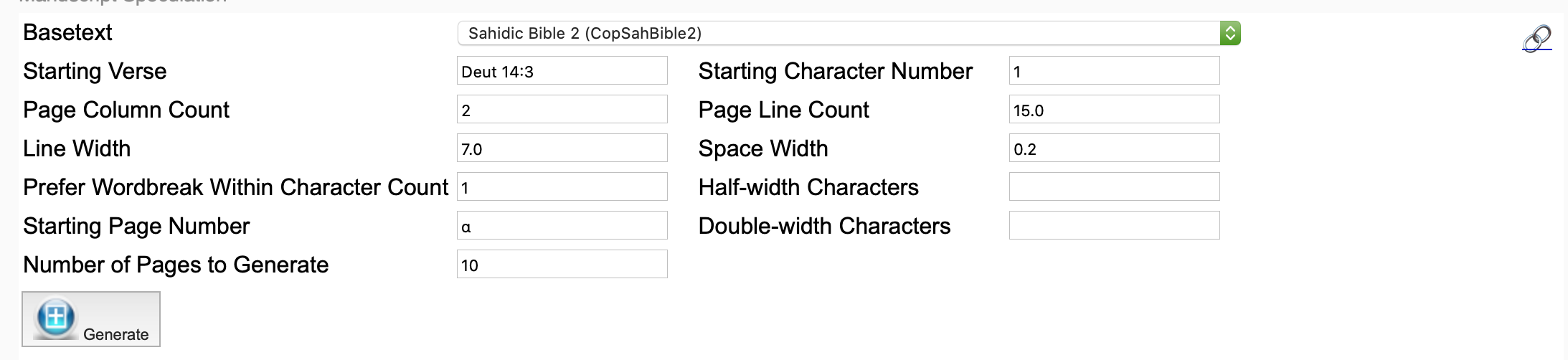
The first parameter, Basetext will be set to Sahidic Bible 2 for our work on the White Monastery leaves.

Starting Verse – here we enter the Biblical verse at which the tool should start a guess. 

Starting Character Number – the character offset within the Starting Verse at which the tool should start to count. If nothing is entered the tool will start the count at the first letter of the first verse.

Page Column Count – the number of columns per page.

Page Line Count – the number of lines per page; you can use a decimal value to account for a range between two numbers.

Line Width – the number of letters per line; you can supply an average decimal value to account for variation of line width within the manuscript. 

Space Width – the fraction of a character width to use between words. 0 for no space between words; 0.5 for half a character width between words, etc.

Prefer Wordbreak Within Character Count – lines can end exactly on the specified Line Width count or can be adjusted slightly if you find that the scribe preferred to end lines on a word break if the word break was within a reasonable amount of characters, e.g. "1" here would allow the line width to adjust by one character more or one character less if it would result in the line ending on a word break. If your strategy is to match the end of an extant page by adjusting fractional line length values, turning this feature off (setting to 0) is ideal.

Half-width Characters – some characters such as iota are often written using less than a full character width both in unimodular and bimodular manuscripts. Supply a list of characters here which should be treated as such.

Double-width Characters – to better support bimodular manuscript, a list of characters can be provided here which should be treated as double the normal character width when they occur on a line.

Starting Page Number – the number of the page at which the speculation should start.

Number of Pages to Generate – the number of successive pages that the tool should generate.

When you refine your parameters to best match your manuscript, you can then save or share those parameters with colleagues by using the “Return Link” icon in the upper right corner of the tool.

From a methodological point of view we are attempting to establish the tendencies of the Coptic scribe as discovered through the extant portions of the manuscript and apply those same tendencies when reconstructing the missing portions. This method was already used in traditional Coptological investigation, however this work was previously done manually and being very tedious, generally only for a few leaves.[1] Now, through the support of DH software we can reach a new level of speed and consistency in applying our expert decisions, thus increasing accuracy and assuring plausibility for our assumptions. This tool is now integrated and available within the Virtual Manuscript Room and can be used not only for the Coptic biblical codices from the White Monastery but also for all Coptic or other language biblical manuscripts. You can find the Manuscript Speculation Tool here.


Finally, we would like to end the first part of our blogpost with five concise suggestions based on what we have learned by using the tool over the past months.  


  • Know your codex thoroughly.
  • Try to reconstruct an extant page in order to prove your speculative parameter values.
  • Use the tool only to close the gap between two leaves, so as not to carry errors onward to the next gap.
  • Attempt to find other possibilities for best speculation values by tuning different parameters.
  • Tolerate errors.  The tool can only speculate and will never be exact.

  In the second part of this blog post we will be using the tool to reconstruct the non-extant portion of the fragmentary manuscript sa 2070. You are invided to follow us there.

---------------------------------------------

[1] D. Atanassova, “Neue Erkenntnisse bei der Erforschung der sahidischen Quellen für die Paschawoche”, in: Heike Behlmer, Ute Pietruschka, Frank Feder (eds.), Ägypten und der Christliche Orient. Peter Nagel zum 80. Geburtstag (Texte und Studien zur Koptischen Bibel 1), Wiesbaden 2018, pp. 1–37, particularly p. 20.


LCBM 1.0 2021 online

The List of Coptic Biblical Manuscripts (LCBM) is now available on our website. LCBM is a common list maintained and regularly updated by the INTF Münster (Siegfried G. Richter and Katharina Schröder) and the Coptic Old Testament project Göttingen. It was the result of an agreement between Siegfried Richter and Frank Feder in 2016 to replace the partly overlapping and competing numbering systems of Karlheinz Schüssler's Biblia Coptica and the SMR (Schmitz-Mink-Richter) list of Coptic New Testament manuscripts. The details are outlined in an article in the Journal of Coptic Studies 22.

Updates to LCBM will appear on an annual basis (or more often if substantial changes occur). The published list is a fixed actual state (version 1.0, March 2021) of a work in progress representing the reconstruction of Coptic biblical and liturgical manuscripts, first for the Sahidic manuscripts. It gives the basic information for each manuscript, of which leaves or fragments in which collections it consists and which verses of a certain biblical book or pericopae they contain, and a concordance of the different numbering systems that exist. In addition, as for the NT manuscripts, also the Horner and GA sigla are noted. Any other detail, like provenance or dating, will be reserved for the comprehensive description of the manuscript in the metadata scheme in the manuscript catalogue. A link at the end of each line leads you, in case of the OT manuscripts, to the diplomatic editions in the CoptOT VMR, also work in progress and, therefore, in different stages of accomplishment, and, in case of the NT manuscripts, to the SMR-Database. For this first version, the column with 'codex type/lectionary type' is mostly left blank, as we are still working with the assignment of the fragments. This, and also the sigla for the manuscripts of the other dialects (except the classical Bohairic version which needs a separate list) will be added successively.

The progress in comparison to Schüssler's Biblia Coptica is already visible in many cases, and we are very grateful for any additional information, suggestions, and improvements you may have.  

Wolf-Peter Funk, 1943-2021


Unser verehrter Kollege, der Anglist, Theologe und Koptologe Wolf-Peter Funk, geboren 1943 im sächsischen Oederan, ist am 18. Februar 2021 im kanadischen Québec gestorben. 

Als Schüler von Hans-Martin Schenke gehörte Wolf-Peter Funk zu den Mitbegründern des Berliner Arbeitskreises für koptisch-gnostische Schriften. Der Berliner Arbeitskreis veröffentlichte ab 1973 sukzessive deutsche Übersetzungen von Nag Hammadi-Schriften, zu denen Wolf-Peter Funk die Übersetzungen des Authentikos Logos (NHC VI,3) und der Lehren des Silvanus (NHC VII,4) beitrug. Seine bereits 1971 fertiggestellte Dissertation über die Zweite Apokalypse des Jakobus aus Nag Hammadi-Codex V erschien dann 1976 als erste kommentierte Textausgabe aus den Reihen des Berliner Arbeitskreises in der Reihe Texte und Untersuchungen des Berliner Akademie-Verlages als TU-Band 119. Wolf-Peter Funk setzte darin mit seiner Indizierung des koptischen Textes den linguistischen Standard, der seitdem die Textausgaben des Berliner Arbeitskreises auszeichnet.

Frühzeitig machte er statistisch-mathematische Methoden für die linguistische Qualifizierung koptischer Texte fruchtbar. Als Pionier computergestützter Analyse trug er wesentlich zur dialektologischen Entschlüsselung insbesondere von Nag Hammadi-Texten bei. Als „Hexenmeister“ (so eine Formulierung von Hans-Martin Schenke) der von Régine Charron entwickelten computergestützten Konkordanzen erschloss er der Koptologie zahlreiche Textcorpora, wovon etliche Koptologinnen und Koptologen seitdem profitiert haben. Am Beispiel dieser Computerkonkordanzen wird besonders deutlich, dass das veröffentlichte Werk Wolf-Peter Funks nur die sichtbare Spitze eines Eisbergs darstellt. Etliche Konkordanzen, etwa zu den sogenannten „kleinen“ Dialekten, erschienen nur als Privatdruck oder wurden großzügig als Disketten geteilt – stets zum Nutzen und zum Fortschritt der Koptologie.

1986 nutze Wolf-Peter Funk einen Studienaufenthalt als visiting professor in Kanada, um den engen und einengenden Verhältnissen in der DDR den Rücken zu kehren. Er lehrte und forschte seitdem an der Université Laval in Québec und veröffentlichte seine wissenschaftlichen Beiträge abwechselnd auf Deutsch, Englisch und Französisch – je nach den Erfordernissen der jeweiligen Publikation.

In den letzten Jahrzehnten hat sich Wolf-Peter Funk besonders um die Erschließung der manichäischen Schriften verdient gemacht, sowohl der bereits seit Jahrzehnten in Bibliotheken aufbewahrten als auch der neugefundenen etwa in der Oase Dachlah. Seine Konkordanzen zu den manichäischen Kephalaia und den manichäischen Homilien gehören zu dem unter der Wasserlinie liegenden Eisberg seines Lebenswerks.

Der Hindernislauf seiner Heimarmenē hat nun ein Ende gefunden. Wolf-Peter Funk war nicht nur Kollege und Koptologe, sondern auch Mensch und Freund. Als ehemaligem Mitglied des Leipziger Thomanerchores lagen ihm auch Alte Musik und historische Aufführungspraxis am Herzen. Diskussionen linguistischer Detailfragen mit seinem Kollegen und Freund Hans-Gebhard Bethge endeten nicht selten im gemeinsamen Hören neuer, aufregender Aufnahmen Alter Musik. Die Lücke, die sein Tod reißt, ist nur zu ahnen.

Peter Nagel Das Deuteronomium sahidisch New volume in TSKB series

Volume 2 in the TSKB (Texts and Sudies on the Coptic Bible) series has just been published with Harrassowitz. Peter Nagel, a nestor in Coptic Studies and one of the best specialists in the research on the Coptic Bible, presents a new edition of the text of Deuteronomy in the early papyrus (4th century) British Library Or. 7594 (sa 17) with a miscellany of Biblical (Deut, Jonah, Acts) and apocryphal texts (Apocalypse of Elijah). The Deuteronomy text is one of the earliest witnesses of the Sahidic Old Testament and its grammar and syntax patterns yield very important examples of an early classical Sahidic. The first edition of the Deutoronomy text in Or. 7594 by Ernest A.W. Budge in 1912 (Coptic Biblical Texts in the Dialect of Upper Egypt) rendered this important document only very inadequately. Finally, Peter Nagel offers an exemplary and reliable edition critically checked, and supplied where the text of the London papyrus is missing, with textual variants of another fourth century papyrus P. Bodmer XVIII (sa 2001) and the complete medieval (9th–10th century) parchment manuscript M 566 (sa 2006). The edition is introduced by a codicological description and a short evaluation of its text character as version of the Septuagint. The text edition is accompanied by a complete translation and explanatory notes. The comprehensive indices explore the Coptic conjugation patterns, the Coptic vocabulary, the Greek loanwords, and the proper names in the text.

While Deuteronomium sahidisch is the first reliable edition of the Deuteronomy text of the London Papyrus, and, at the same time, the first complete edtion of the Sahidic version of this book, it is neither a complete editon of Or. 7594 (sa 17) nor a critical edition of the Sahidic Deuteronomy yet. This will soon be realised by our project in a digital edition in the VMR. Nevertheless, Deuteronomium sahidisch is a very important intermediary step on the way there. 

Eusebian Tituli Psalmorum in the Coptic Psalter Codex sa 2033

Since the publication of my last post, I have gained some new insight into the Coptic Psalter Codex sa 2033, which I am sharing below. 

1. Following a valuable hint given to me by Professor Rainer Stichel,[1] I consulted the series of Psalm titles written by Eusebius of Caesarea around 330 AD [2] and reproduced by Jacques-Paul Migne [3] under the heading Υποθεσεις του αυτου ευσεβιου εισ τουσ ψαλμουσ. As noted by Martin Wallraff, it is “a shortlist by Eusebius of the subject matter of each of the 150 Psalms”.[4] This shortlist precedes the Psalms in the famous fifth century manuscript Royal MS 1 D VII known as Codex Alexandrinus preserved in the British Library in London.[5] 
It turns out that the headings appearing in the Coptic Psalter sa 2033 are a quite literal translation of the Eusebian Psalm titles. Let me illustrate this with the titles preceding Psalms 64 and 65; the table below is followed by a detail of the manuscript showing the beginning of Psalm 64. 

Detail of Berlin, SBB, Ms. or. Fol. 1605, f. 3r. http://resolver.staatsbibliothek-berlin.de/SBB0001C5A400000017 (Licence: CC BY-NC-SA 3.0 DE)

I checked each of the Psalm titles extant in sa 2033 and was able to ascertain that the Sahidic titles correspond to the Eusebian ones except for the titles of Psalms 146 and 148 (coincidentally being those reproduced in my previous post). I have now found out that these two titles appear in Latin in several manuscripts and belong to what Pierre Salmon calls the first series or “Série de Saint Colomba”. The Christian titles of this series are widely attested in Europe as early as the sixth century “quelles que soient ses origines plus lointaines”.[6] The fact that they appear in our Sahidic manuscript suggests that their origin must certainly be Greek. In a longer article I am currently working on I will give the complete comparison between the Eusebian tituli Psalmorum and those appearing in sa 2033.

2. Searching through the Göttingen VMR for other Coptic witnesses of the Eusebian tituli Psalmorum, I discovered that two London fragments classified by Karlheinz Schüssler as a codex of their own with the siglum sa 185 [7] actually belong to sa 2033 (BC sa 101). The London fragments in question are 

  • London, BL, Or. 6954 (96), a fragment complementing Cairo, CM, Inv. no. 3854 bearing Ps 24:7–15; 25:1–9, and
  • London, BL, Or. 6954 (98), a fragment bearing Ps 67: 21–26; 68: 1–5 to be placed between Berlin, SBB, Ms. or. fol. 1605, f. 3 and Paris, BnF, Copte 133(2), f. 26b. 

The new fragments also contain the Eusebian tituli Psalmorum, and this brings the identified parts of sa 2033 to 26 fragmentary folios dispersed among 7 libraries. All 26 leaves are now freely available in the Göttingen VMR in the correct order with the indication of their content.

[1] Rainer Stichel is the author of the book Beiträge zur frühen Geschichte des Psalters und zur Wirkungsgeschichte der Psalmen. Paderborn et al.: Verlag Ferdinand Schöningh, 2007. Also see his article Zur Herkunft der Psalmenüberschriften in der Septuaginta, in: Erich Zenger (ed.), Der Septuaginta Psalter. Sprachliche und theologische Aspekte. Freiburg et al.: Herder, 2001, 149–161.
[2] On the possible date Eusebius of Caesarea (also called Eusebius Pamphili) wrote his hypotheseis, cf. William Smith and Henry Wace, A Dictionary of Christian Biography, Literature, Sects and Doctrines. London: Little, Brown and Company, 1880, 308–355 at p. 336–337.
[3] Migne, PG 23: 68–72.
[4] Martin Wallraff, The Canon Tables of the Psalms, An Unknown Work of Eusebius of Caesarea, in: Dumbarton Oaks Papers 67 (2013), 1–14, 9. As for the number of 150, note that all witnesses of Eusebian Psalm titles refer to 150 Psalms following the Masoretic tradition (unlike the LXX, which has 151 Psalms). The Latin translation of the Eusebian Psalm titles constitutes the Série IV in Pierre Salmon, Les “Tituli Psalmorum” des manuscrits latins, Collectanea Biblica Latina XII. Rome: Abbaye Saint-Jérôme and Libreria Vaticana, 1959, 117–131.
[5] See fols. 531v–532v in The Codex Alexandrinus in reduced photographic facsimile, The Old Testament, part IV, published by the Trustees of the British Museum in 1957. It also features in other Greek Psalm manuscripts and Catenae. Some examples are Oxford, BL, MS. Auct. D. 4.1, f. 26r–28v (10th century), and Rome, BAV, Reg. Gr. 1, f. 488v–490r (10th century). More examples and a discussion can be found in Cordula Bandt, Eusebius Periochae, in: Cordula Bandt, Franz Xaver Risch and Barbara Villani (eds), Die Prologtexte zu den Psalmen von Origenes und Eusebius, Texte und Untersuchungen zur altchristlichen Literatur 183. Berlin/Boston: De Gruyter, 2019, 122–141.
[6] Salmon, Tituli, 47.
[7] Karlheinz Schüssler, Das sahidische Alte und Neue Testament, Biblia Coptica 2.2. Wiesbaden: Harrassowitz, 2015, 17–18, sa 185.

CoptOT Blog Entries