Blogs Blogs

Camplani Lecture on YouTube

Alberto Camplani's recent lecture The Patriarchal Institution in Egypt and its Ideology between Demetrius and Isaac: Old and New Documents is now available on our YouTube channel. We like to thank Alberto, who was the first speaker in our Online Lecture Series Material and Written Culture of Christian Egypt, for giving us permission to record his presentation.


Online Lecture Series: Material and Written Culture of Christian Egypt

We are pleased to inform you that the Digital Edition of the Coptic Sahidic Old Testament research project at the Göttingen Academy, in collaboration with the Seminar for Egyptology and Coptic Studies at the University of Göttingen, will soon begin a lecture series entitled Written and Material Culture of Christian Egypt.

The lectures will be held monthly by established scholars in the field and will focus on different topics related to the Christian communities in Egypt from the second century CE until the Ottoman period. The lecture series will be held in online format as Zoom webinars.

While the audience can attend the lectures free of charge, registration is required. If you want to get the Zoom access link, please feel free to email me and I will send it to you in due time (typically one day before the scheduled lecture). NB: As the number of attendees is limited, access requests will be dealt with in the order in which they arrive.

The first lecture in our series will be held by Alberto Camplani from the Sapienza University of Rome on Wednesday, October 21, from 16.30 CET. His paper is titled “The Patriarchal Institution in Egypt and Its Ideology between Demetrius and Isaac: Old and New Documents.”

Please feel free to circulate this information and the attached poster.

Here is a brief sketch of Camplani’s paper:

“This paper takes into consideration some historiographical and hagiographical compilations produced in the milieu of the bishopric of Alexandria and in the lay and monastic circles linked to this institution, from the fourth to the seventh centuries CE. Through the analysis of certain characters and images, it will be offered an outline of the various evolving conceptions regarding the role of the Alexandrian see within the Mediterranean Church and the political system of the Eastern Roman Empire.”

Alberto Camplani is professor of Early Christian Literature at the Sapienza University of Rome. He also teaches courses on Syriac literature and Greek Patristics at the Institutum Patristicum Augustinianum. Former professor of New Testament philology and exegesis in the Catholic University of Milan (2016-2019). Former editor of Studi e materiali di storia di religioni (2009-2012). Since 2013 he is director of Adamantius. Annuario di Letteratura Cristiana Antica e di Studi Giudeoellenistici. A member of the “International Association for Coptic Studies”, he was Congress secretary on the occasion of the Tenth International Congress of Coptic Studies in Rome, 2012. He is a member of some committees for the evaluation of the historical research in Italian Universities. His researches concern early Christianity in Syriac and Coptic language (Bardaisan, Aphrahat, Ephrem), episcopal institutions in Late Antiquity (Athanasius, Cyril, Timothy, Damian, Benjamin), Gnostic and Hermetic texts, Marcionism in the East. 

On an uncommon Arabic 'probatio pennae' in the Holy Week Lectionary Codex sa 292L

Codex sa 292L, Oxford, BL, Huntington 5 is a partially extant Sahidic Coptic Holy Week Lectionary consisting of a first longitudinally torn half folio and another 36 folios. Apart from the main texts written in Coptic, the codex contains short Arabic headings, an extended Arabic instruction addressed to the congregation, and a seven-line marginal note written in Arabic at the bottom of one of the folios (f. 23r, reproduced at the end of this blog entry). The examination of this marginal note yielded an unexpected result. The marginal note turned out to be the unique example of an elaborate Arabic probatio pennae (pen trial) in a Coptic manuscript.
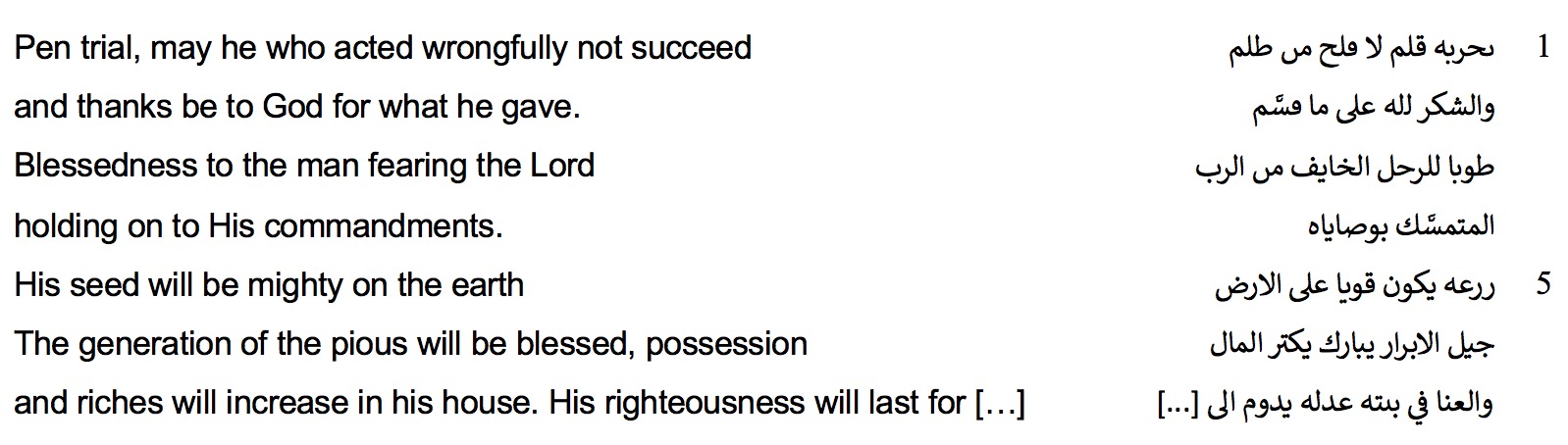
The genre of probationes pennae or pen trials is encountered in innumerable manuscripts and in more than one tradition. It materializes on flyleaves or in marginalia in a great variety of forms, including jottings, catchwords, or nonsensical words. In the European medieval tradition, when trying their pen, scribes resorted also to miniatures, caricatures, or simply wrote the words probatio or probatio pennae, always in Latin, sometimes accompanied by more text not necessarily in Latin. My research on manuscripts originating from the medieval Middle East unveiled an additional particularity in the pen trial occurrences. The Hebrew pen trial tradition features a rhyme-property with several examples of pen trial texts in rhyming verses, which seems to be lacking in the European medieval pen trial tradition. The Hebrew pen trial tradition seems to find its pendant in Arabic, therefore allowing us to speak of a Semitic tradition. In examples produced in the Middle Eastern region, the words ‘pen trial’, in Arabic taǧribat qalam, or similar formulae are always the first words of two hemistichs ending with a perfect rhyme. In this tradition, while the second hemistich invariably includes the words lā falaḥ or lā aflaḥ man ẓalam ‘may he who acted wrongfully not succeed’, the first hemistich may use the noun qalam ‘pen’ rhyming it with the verb ẓalam ‘(he) did wrong or acted wrongfully’, or variants with the words ḥibr or midād ‘ink’ instead of pen, evidently triggering other rhyming end words. A fourth pen trial tradition might be worth mentioning. It is the Judeo-Arabic one which is well represented in the Cairo Genizah fragment collection in Cambridge. An examination of the collection showed dozens of occurrences of the Arabic words תגרבה taǧribah ‘trial’, קלם תגרבה taǧribah qalam ‘pen trial’ and even חבר תגרבה taǧribah ḥibr ‘ink trial’ written in Hebrew characters, however lacking a second rhyming hemistich.

To come back to the seven-line marginal note in the manuscript at issue, the first line of the probatio pennae follows the above-mentioned formulaic Arabic pen trial, rhyming qalam with ẓalam. Yet diverging from the Arabic pen trial tradition, the scribe adds a second verse, ending with qasam ‘(he) gave’ (lit. ‘he allocat­ed’), a procedure that is not found among the samples of Arabic (and Judaeo-Arabic) pen trials, in which the formulaic verse usually appears on its own. The scribe drives the innovation further by adding the first three verses of chapter 111 of the Septuagint Psalter. The latter have turned out to be interesting by themselves, being taken from an Arabic Bible tradition based on a translation from the Syriac Peshitta. The search for representatives of the Arabic taǧribat qalam tradition has yielded many examples of both Muslim and Jewish manuscripts; so far, codex sa 292L seems to feature the first occurrence discovered in a Christian manuscript. The pen trial was most probably written by an anonymous Coptic scribe with a sophisticated knowledge of Arabic at a time when codex sa 292L had ceased to be in liturgical use.

For more details on what seems to be the first known example of an Arabic pen trial in a Coptic manuscript, see my article in the Journal of Coptic Studies 22 (2020), 69–93.


Ms. sa 292L, f. 23r: Coptic text with Arabic probatio pennae
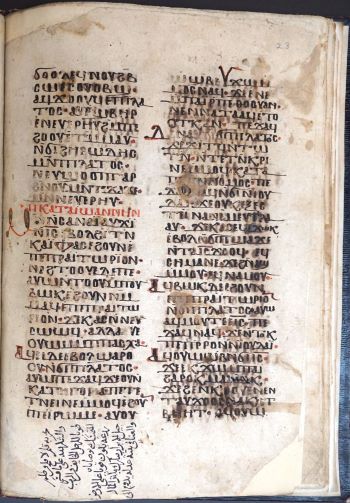
© Malte Rosenau. Published with the kind permission of the Bodleian Library

Hidden Books of the Coptic Old Testament

For my current research on the biblical Book of Ruth, I had to check the palimpsest codex Add 17183 in the British Library, London. This parchment manuscript with two superimposed layers of writing originated in the monasteries of Scetis in Lower Egypt and was worked on on two occasions: the original manuscript from the 7th century CE contained Coptic biblical texts from the Old Testament including the Books of Joshua, Judges, Ruth, Judith, and Esther. Three centuries later, the codex was rewritten in Syriac with a selection of sayings and writings of the Church and Desert Fathers.

Nowadays, the underlying Coptic text is invisible to the naked eye. However, multispectral imaging has proven to be a promising technique in palimpsest manuscripts, and a cooperation between our project and the British Library was initiated – especially with Ilana Tahan, Lead Curator, Hebrew & Christian Orient Studies, and Christina Duffy, Imaging Scientist.

The results have been amazing. The multispectral images provided by the British Library have made the Coptic text visible and readable to a very large extent by fading out the Syriac text. This has been of invaluable importance for our work.

After obtaining these marvellous results the idea of a joint „showcase“ arose and was immediately realised. You can find out more here: https://www.bl.uk/collection-items/Coptic-Old-Testament-Book-of-Ruth

On the website you can choose between three views of the manuscript: the “Normal View”, the "PCA View" (showing the multispectral images) and the "Transcript" (Coptic transcription).

The „Digital Edition of the Coptic-Sahidic Old Testament“ hopes to continue this fruitful cooperation with the British Library for its mutual benefit to both institutions. I would like to use this opportunity to express my thanks to the British Library team: Ilana Tahan, Christina Duffy and the IT specialist Richard Power – as well as to my colleagues Chrysi Kotsifou and Malte Rosenau for their support in this project.

The Coptic Old Testament Newsletter

From Fragments to Books
We're happy to annouce the first issue of From Fragments to Books, the official newsletter of the Coptic Old Testament Project. Published bi-annually in PDF format, the newsletter will offer reports and background information on the project and the edition of the Coptic-Sahidic Old Testament. If you wish to receive future issues of this newsletter automatically, please subscribe to our copt-ot-newsletter mailing list.

CoptOT Blog Entries