Blogs Blogs

Solving the Mystery of One of the “Earliest Greek Lectionaries”

For more than a century, five parchment leaves preserved in the Austrian National Library in Vienna (P. Vindob. G 2324) have been regarded as one of the oldest surviving Greek Gospel lectionaries. In the Gregory-Aland list of Greek New Testament manuscripts, they feature as Lectionary 1043.

In a new article published in Novum Testamentum, I argue that this common assumption is mistaken. By reconstructing the original manuscript from scattered fragments now preserved in libraries across the world, I demonstrate that the Vienna leaves belonged to a codex from the famous White Monastery in Upper Egypt. The codicological reconstruction reveals that the Greek passages were copied by the same scribe at the end of a manuscript containing the four gospels in Sahidic.

This discovery alters the presumed character of the Vienna leaves entirely. What had been considered one of the earliest Greek lectionaries turns out instead to be the work of a bilingual Egyptian scribe active in the seventh century.

My investigation also led to several other unexpected discoveries. I identified previously unknown fragments of the same codex, currently held in collections in Paris, Oslo, Vienna, and among the tiny parchment scraps excavated in 2011 at the White Monastery. I was also able to find another Sahidic New Testament manuscript – containing the Acts of the Apostles and the Catholic Epistles – copied by the same scribe.

Perhaps the most fascinating aspect of the manuscript I pieced together is its sophistication. The scribe employed a series of scholarly tools borrowed from the Greek biblical tradition, such as the Ammonian-Eusebian apparatus, Gospel chapter cross-references, and stichometric counts. These features are unattested elsewhere in Sahidic manuscripts of the gospels, which demonstrates that the White Monastery was a significant learning center during the Coptic period.

The remaining puzzle is why these Gospel extracts in Greek were added at the end of a Coptic manuscript. My study argues that the scribe sought both to avoid wasting valuable parchment and to preserve a selection of important Gospel readings in Greek. Thus, this bilingual manuscript offers a rare glimpse into a period when Greek still retained a privileged status in the Coptic Church.

But beyond recovering the purpose of the manuscript to which the Vienna leaves originally belonged, I hope my study contributes to a broader methodological perspective. Greek and Coptic manuscripts from Egypt are often studied separately, as if they belonged to different worlds. My article implicitly argues that they should instead be approached together. Only by viewing them within the same bilingual scribal culture can we properly understand how manuscripts were produced and used in late antique Egypt.

Recently published: TSKB 5 – Die koptischen Miniaturkodizes aus spätantiker Zeit (Coptic Miniature Codices from Late Antiquity)

It is not only the content but also the format of late antique manuscripts that can reveal interesting facts about the use and functions of biblical and non-biblical literature in Roman-Byzantine Egypt. Recently, there has been increased research on particularly small-format codices, as demonstrated by Michael J. Kruger’s monograph “Miniature Codices in Early Christianity,” published in 2025. In his work, Kruger primarily examines Greek manuscripts of the smallest format containing Christian texts. However, this type of codex was also widespread in Egypt among Coptic manuscripts. This became clear several years ago when Alin Suciu published a list of Coptic miniature codices

Building on this and other studies, a monograph has recently been published, which, in appr. 600 pages, for the first time explicitly examines Coptic miniature codices from the late antique period. Jan-Malte Ziegenbein’s work defines and catalogues a corpus of over 140 Coptic manuscripts of a particularly small format that can be dated to the 4th–8th centuries. Based on content, material, palaeographic, and linguistic-orthographic characteristics, conclusions are also drawn regarding the dating, origin, and function of the codices.

The work originated as a PhD thesis at the University of Göttingen, supervised by Prof. Heike Behlmer and Dr Frank Feder. It has now appeared as the fifth volume of the series Texte und Studien zur Koptischen Bibel / Texts and Studies on the Coptic Bible (TSKB) distributed by the Harrassowitz Verlag, Wiesbaden.


Psalter & Gospel of Matthew. Dublin, Chester Beatty Library, Copt. Ms. 815, fol. 152r. Approx. 10.5 x 8.5 cm (h x w), 6th–7th century. Source: https://viewer.cbl.ie/viewer/image/Cpt_815/305/.


A key to defining a corpus of Coptic miniature codices: In the colophon of Copt. Ms. 815 at the Chester Beatty Library in Dublin, the manuscript itself is explicitly referred to as ⲡⲉⲓ̈ⲕⲟⲩ<ⲓ> ⲛ̄ϫⲱⲱⲙⲉ “this small book”.


Curatorial Position in Egyptology at the Ägyptische Museum und Papyrussammlung in Berlin

A new position has opened at the Egyptian Museum and Papyrus Collection in Berlin, which possesses one of the largest collections of papyri in the world.

The museum is currently seeking a wissenschaftliche*r Mitarbeiter*in / Kurator*in in the field of Egyptology. The position offers the chance to work closely with one of the most significant collections of Egyptian antiquities and papyri.

The position combines scholarly research with curatorial responsibilities, including collection-based work, exhibition development, and contribution to broader institutional projects. It is particularly well-suited for candidates interested in bridging academic Egyptology with museum practice and public engagement.

Applicants are expected to have a strong academic background in Egyptology, along with relevant research and, ideally, curatorial or collection-related experience.

Further information and application submission can be found here.

New Position in Egyptology & Coptology at Georg-August-Universität Göttingen

Colleagues in Egyptology and Coptology may be interested in a newly advertised two-year position at the Seminar für Ägyptologie und Koptologie in Göttingen.

A full-time position (wissenschaftliche*r Mitarbeiter*in, E13 TV-L) is now open, starting at the earliest possible date. The appointment is limited to two years and is designed to support advanced research, particularly the completion of a second major project (e.g. a habilitation).

The role combines research and teaching. The successful candidate will contribute to courses in Egyptian and Coptic language, literature, and the cultural history of Egypt from the Pharaonic period through Late Antiquity, alongside participation in supervision, examinations, and departmental activities.

Applicants are expected to hold a PhD in Egyptology (or a closely related field), demonstrate strong publication and teaching experience, and command all stages of the Egyptian language. Familiarity with digital research is also required.

Application deadline: 12 May 2026

Further details and application instructions are available here.

Coptic Manuscript Fragments at Trinity College, Cambridge

The manuscript collections of Trinity College, Cambridge, are famous for their treasures. However, less well known is a relatively small but intriguing group of fragmentary Egyptian papyri in a variety of languages. These materials, now fully digitised by the Wren Library, are accessible online.

The papyri are stored in boxes labelled according to language: “Greek,” “Coptic,” and “Arabic.” However, even a cursory inspection shows that these divisions should be treated as approximate: for example, fragments classified as “Coptic” contain Greek material, and vice versa. Furthermore, the collection includes the so-called “Murray Papyri,” which were donated by A. G. W. Murray (1884–1919) to the Library. These also appear to include additional Coptic pieces.

The bulk of the collection consists of documentary texts on papyrus. Yet scattered among them are occasional literary texts on papyrus, parchment, and paper. Until now, only the Arabic material has been preliminarily inventoried by Petra Sijpesteijn. In this post, I would like to draw attention to the small group of Coptic biblical fragments in this collection.

Biblical Fragments from the Pauline Corpus

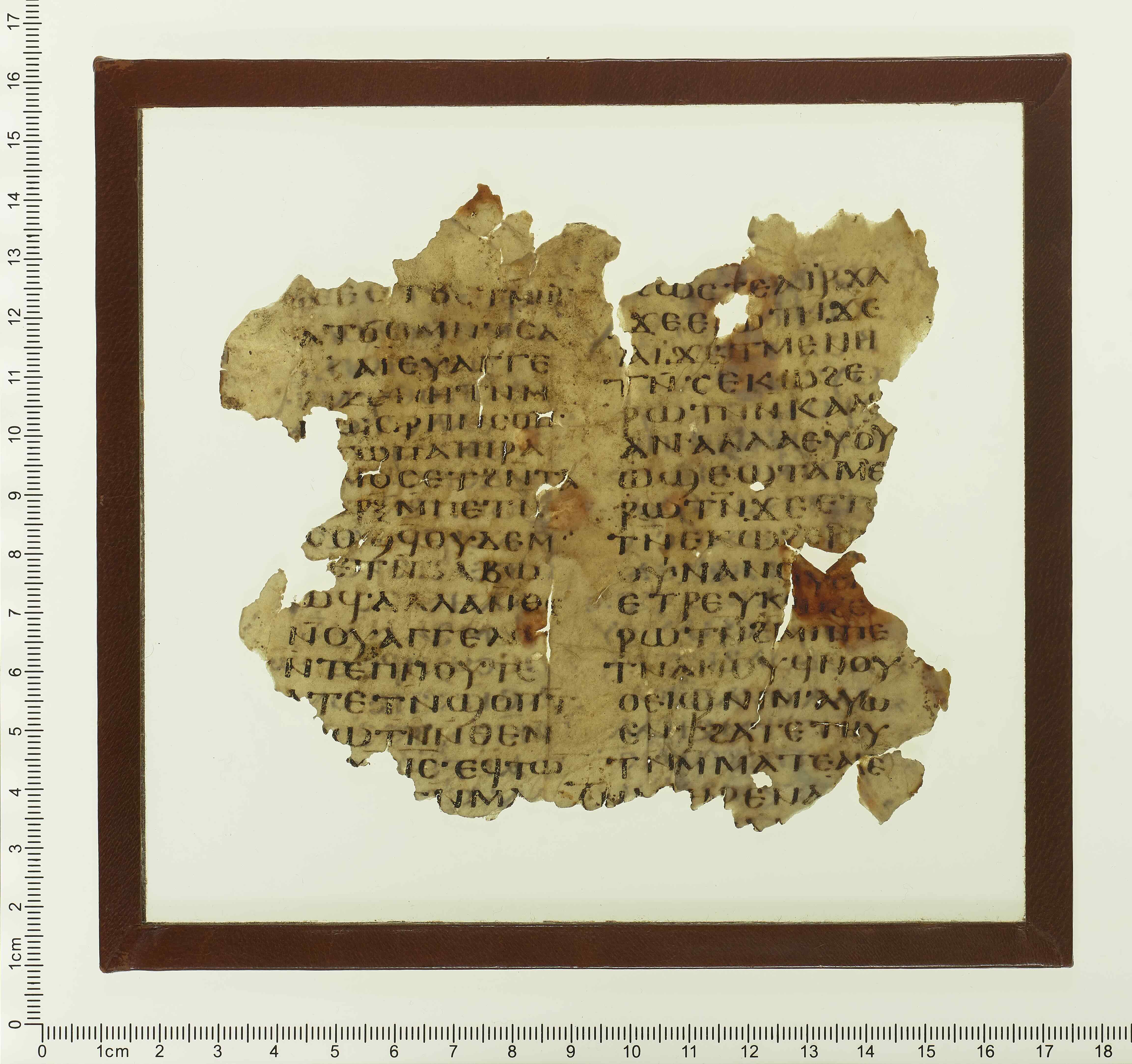
One of the most striking parchment pieces is the last, unnumbered Murray fragment, which contains a portion from the Epistle to the Galatians (4:13–26) in Sahidic. Its script suggests a date as early as the sixth century, making it a valuable witness for the transmission of the Pauline corpus in this dialect.
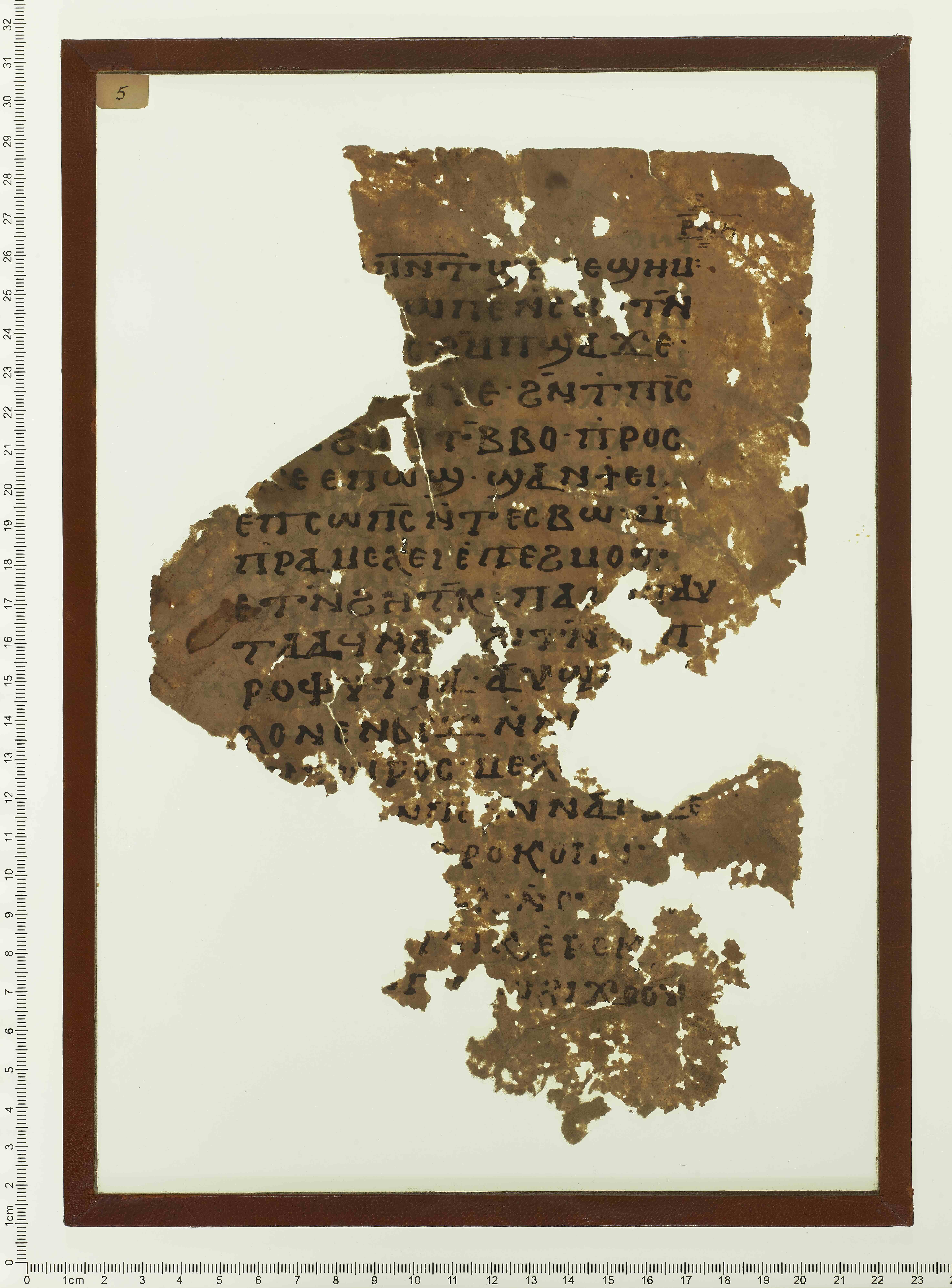
A Sahidic paper fragment from the same group, Murray 5, preserves First Epistle to Timothy 4:12–5:4. The fragment is paginated 158/159 (even/odd!), which suggests that it once belonged to a substantial codex. On palaeographical grounds, it is unlikely to predate the thirteenth century CE, and thus belongs to the final phase of Sahidic as a literary language.
A Gospel Fragment


Among the papyri inventoried as Coptic, perhaps the most noteworthy is “Coptic 17,” which derives from a papyrus codex of the Gospel of John. The fragment is written in a handsome Alexandrian uncial, pointing to a date in the seventh or eighth century.
Other Interesting Material

Among the fragments grouped as “Coptic 15,” one item (no. 7) appears to be liturgical. By contrast, item 6 from the same frame is clearly documentary, probably an account in Sahidic. The verso was subsequently reused to accommodate a private letter in Arabic. The importance of this document lies in the fact that the Sahidic text preserves a precise date: the month of Mesore, year 661 of the Era of the Martyrs, corresponding to July/August 945 CE.
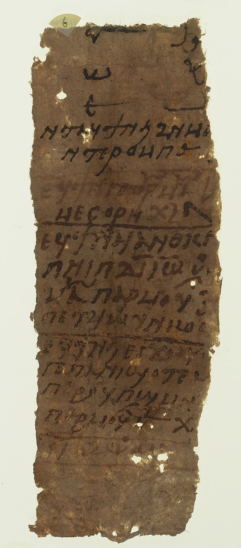
Assuming that this is indeed the date when the Coptic text was written, the document in question is particularly noteworthy, as it may represent one of the earliest securely dated Coptic paper manuscripts. The transition from papyrus and parchment to paper in medieval Egypt remains poorly understood. Although paper had already come into widespread use in the Islamic caliphate, Coptic scribes appear, at least into the tenth century, to have reserved paper primarily for more ephemeral or utilitarian texts such as accounts and letters. By contrast, parchment continued to be preferred for biblical, liturgical, and other literary manuscripts. In this context, parchment functioned not only as a more durable writing surface, but also as a material marker of authority and prestige.

CoptOT Blog Entries