Blogs Blogs

Psalms International Conference 2025

From March 25th to 27th, the University of Malta hosted the conference ‘The Book of Psalms and its Plurality: Textual Transmission, Exegetical Methodology, and Theological Hermeneutics.’ The conference was organized by Prof. Daniela Scialabba (Pontificio Istituto Biblico), Rev. Prof. Dr Marco Pavan (Pontificia Università S. Tommaso D'Aquino), and Rev. Prof. Dr Stefan M. Attard (L-Università ta’ Malta). Its aim was to stimulate discussion on the formation and interpretation of the Psalms in the light of manuscript evidence. Participants came from Italy, Germany, Malta, the United Kingdom, France, Sweden, the Netherlands, South Africa, and the United States. They primarily explored Hebrew, Greek, and Syriac manuscripts. Some of the key questions that were addressed were: What is the impact of the study of the manuscript tradition on the methodological discussion about the reconstruction of the Redaktionsgeschichte of the Psalter? Does textual evidence still support the idea of the Psalter as a book? What is the relationship between the Hebrew, Greek, and Syriac manuscript traditions of the Psalter? 

I was the only participant who presented on the Coptic manuscripts of the Psalter. The title of my presentation was ‘The Psalms in the Coptic Tradition from Late Antiquity to the Early Middle Ages,’ and my analysis was three-fold: Firstly, I described the surviving Coptic manuscripts of the Psalms. Secondly, I emphasised the relationship of the Coptic Psalms with the Greek tradition and how the Greek Psalms in P. Bodmer XXIV have helped us highlight the numerous times that the Coptic classical text of the Psalms reflects a much earlier Greek tradition than the one solidified in the Septuagint. Finally, I presented our published, digital edition of Psalm 90. 

All in all, the conference was meticulously organized; all papers were insightful and thought-provoking; and the University of Malta was a most cordial host. During the Easter holidays, though, the saddest news was shared with us by Brent Strawn and Drew Longacre, the directors of the Critical Edition of the Hebrew Psalter Project. They announced that the federally-funded grant through the National Endowment for the Humanities to produce the Critical Edition of the Hebrew Psalter was summarily terminated without warning by the US federal government. They added that ‘we are forever grateful and we remain committed to bringing this work to completion as opportunity allows. We are convinced it is of great importance for biblical studies, Bible translation, and larger communities of faith, and we also wish to honor the work our volunteers and supporters have done. Indeed, one of the things that makes us most upset about this termination is that it is not just a cancellation of two researchers at a university somewhere. It is a cancellation of the work of some 200 volunteers drawn from across the world—indeed from every continent on the planet except Antarctica. Thankfully, none of that transcription work will be lost, but for the foreseeable future we will be considerably limited in our ability to manage new transcription work and construct the edition itself.’

Birmingham Conference on The Pauline Epistles and the Ancient Versions

Our AHRC/DFG project partner Hugh Houghton from the Institute for Textual Scholarship and Electronic Editing (ITSEE) of the University of Birmingham convened scholars from all over the world for an international conference on The Pauline Epistles and the Ancient Versions. The conference was not only the final meeting of the (AHRC/DFG funded) GALaCSy project team, but also the 14th Birmingham Colloquium on the Textual Criticism of the New Testament. From our team Julien Delhez (now Louvain) and Frank Feder, as members of the GALaCSy Göttingen team, took part with papers on the Coptic transmission of the Pauline Epistles. In the three years of the GALaCSy project, Göttingen and Münster were responsible for the edition of all extant Coptic manuscripts of Galatians and Ephesians, with a special focus on the earliest witnesses. Although we were able to fulfil this task within the (only) three years of funding, mainly thanks to the well-preserved Sahidic manuscripts, such as sa 4, it has quickly become quite obvious that we have only discovered the tip of the iceberg. The Coptic versions of the Pauline Epistles are extant in many, but mostly fragmentary manuscripts that already existed in all known literary dialects of Coptic: Bohairic, Fayyumic, Mesokemic, Akhmimic, Lycopolitan, and Sahidic as early as the 4th century. Along with the psalms and the Gospels, the Pauline Epistles are the best-preserved books of the Coptic Bible. Much remains to be discovered that could shed new light on the textual history of the Greek New Testament.

The GALaCSy Team

Mapping Coptic Manuscripts: A Visit to Cambridge University Library

Between April 14 and 16, 2025, my colleague Frank Feder and I undertook a research trip to the Cambridge University Library (CUL) as part of our ongoing work for the Coptic Old Testament Project in Göttingen. Our aim was to study and photograph Coptic manuscripts held in the collections of the library. In this post, I will report on these collections and highlight some of their most important pieces.

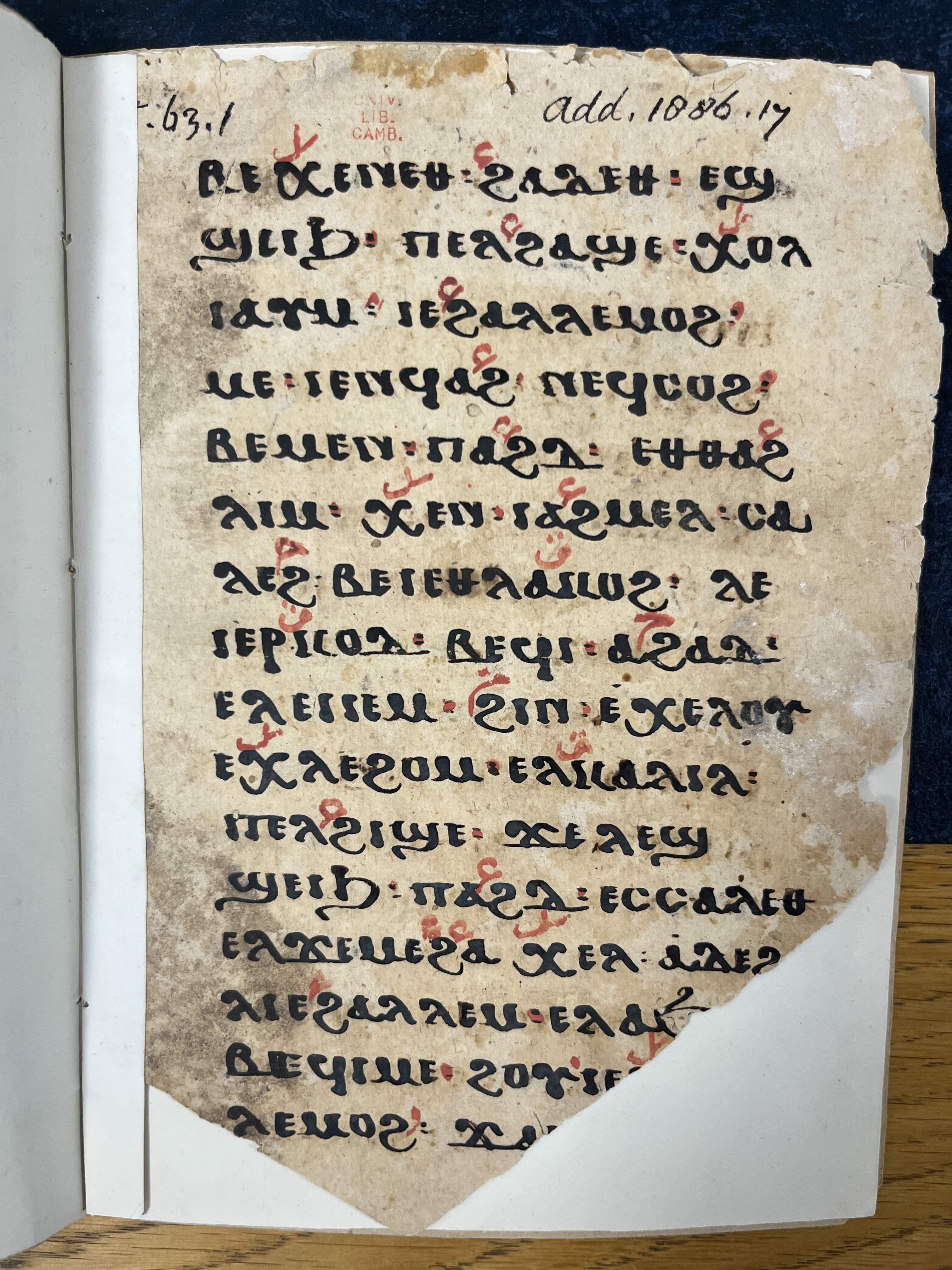
The Coptic and Copto-Arabic fragments at CUL originate from several sources. A substantial portion was acquired from the famous German scholar Constantin von Tischendorf (1815–1874), who brought them from Egypt during his travels. These fragments, inventoried as Add. 1875–1876 and 1885–1887, include some of the most valuable Coptic holdings of the library. Among them are parchment and paper fragments in the Bohairic dialect, which Tischendorf had brought from Wadi Natrun. These were later published by Hugh Evelyn-White (1884–1924) in the first volume of his The Monasteries of Wadi ’N Natrûn (1926). Particularly notable is Add. 1886.17, which contains Abba Isaiah’s Precepts to the Novices. Although the language of this manuscript is Arabic, it is written in Coptic characters.
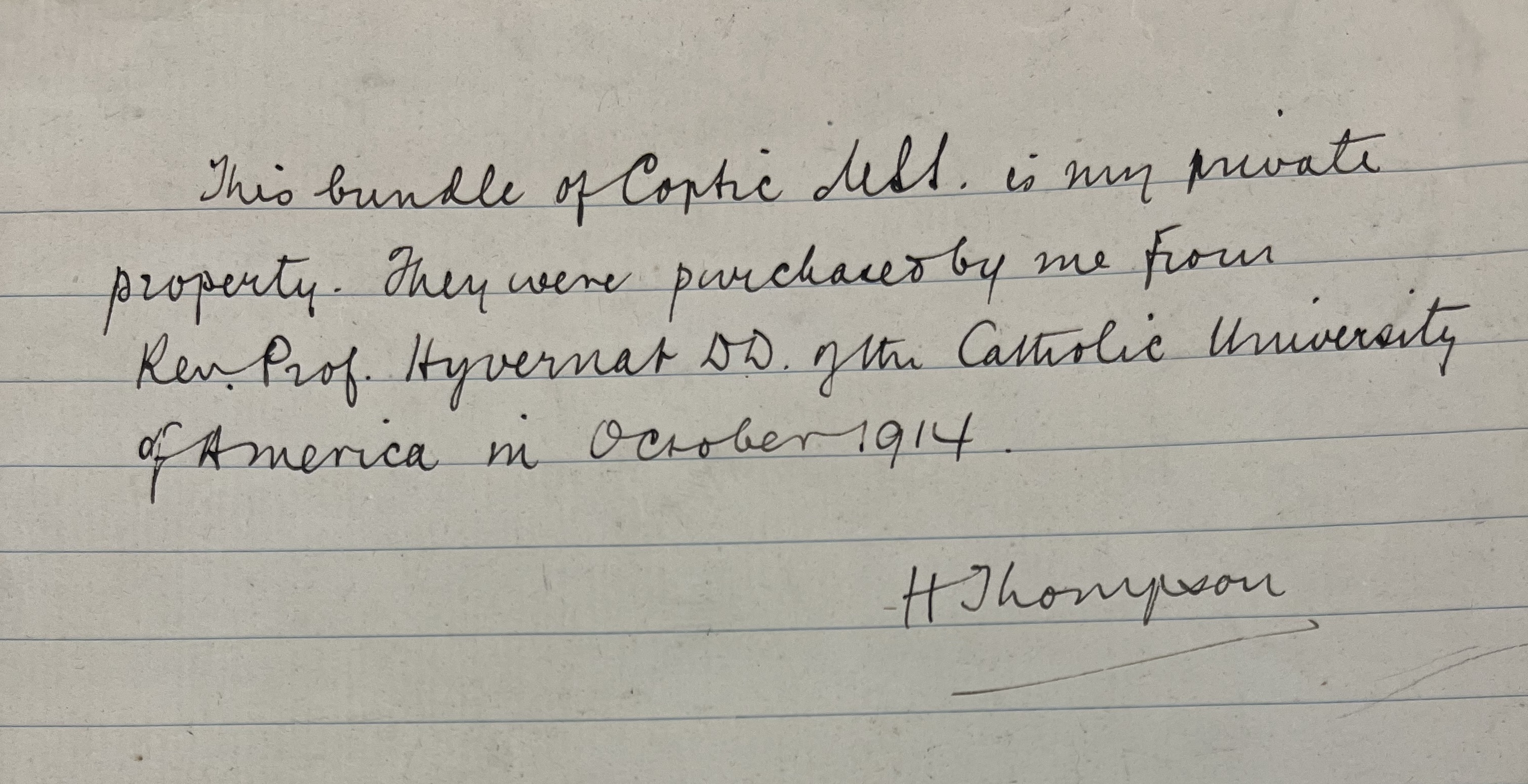
Another major source of the CUL’s Coptic collection is the group of fragments that belonged to Sir Herbert Thompson (1859–1944), professor of Egyptology at the University of Cambridge. These are inventoried as Or. 1699. During our research, we also examined Thompson’s correspondence and notes, which revealed that he purchased these fragments in 1914 from Henry Hyvernat (1858–1941), professor at the Catholic University of America in Washington, DC.
 

The Thompson fragments are particularly significant because they originate exclusively from White Monastery codices. Since fragments of these codices are now scattered across more than forty collections worldwide, the Thompson material is invaluable for reconstructing the original White Monastery manuscripts.

An unexpected find came from a box inventoried as Or. 1700 (Box 1), which contains numerous smaller fragments, apparently acquired by Thompson together with those now kept as Or. 1699. Surprisingly, these fragments had remained largely overlooked until now. Among them, we identified previously unattested biblical and liturgical pieces, as well as fragments of the works of Shenoute, hagiographic texts such as the Martyrdom of Cyprianus and Justina, and apocryphal writings like the Acts of Andrew and the Acts of John attributed to Pseudo-Prochorus.

Another important part of the CUL’s Coptic holdings comes from the collection of George Michaelides, which was acquired by the library in 1977. Although much of the Michaelides collection is formed of documentary papyri, it also includes a significant number of biblical and literary fragments. Among the highlights we identified is a parchment fragment containing Sirach 50:19–20, 24–27 in the Fayyumic dialect (Cambridge, UL, Mich.Pap.Q.118). This is the first known attestation of the book of Sirach in Fayyumic. Furthermore, the paleographical features of the fragment suggest an early date, likely the 5th century CE.

We also identified two Sahidic fragments (Cambridge, UL, Mich.Pap.Q.119–120) forming a leaf from a miniature codex, which preserve a portion of the Life of Paul of Tamma attributed to his disciple Ezekiel. This hagiographic work survives fully in Arabic, but only fragmentarily in Coptic. The section preserved in the Michaelides fragments had previously been unattested in Coptic, making this a particularly exciting find.

In addition to the manuscripts associated with Tischendorf, Thompson, and Michaelides, the CUL also holds two smaller collections of Coptic fragments that formerly belonged to Jack Plumley (1910–1999), professor of Egyptology at Cambridge, and Frederick William Green (1869–1949), Honorary Keeper of Antiquities at the Fitzwilliam Museum. These collections consist of biblical and literary texts in Sahidic and Greek, mostly written on papyrus.

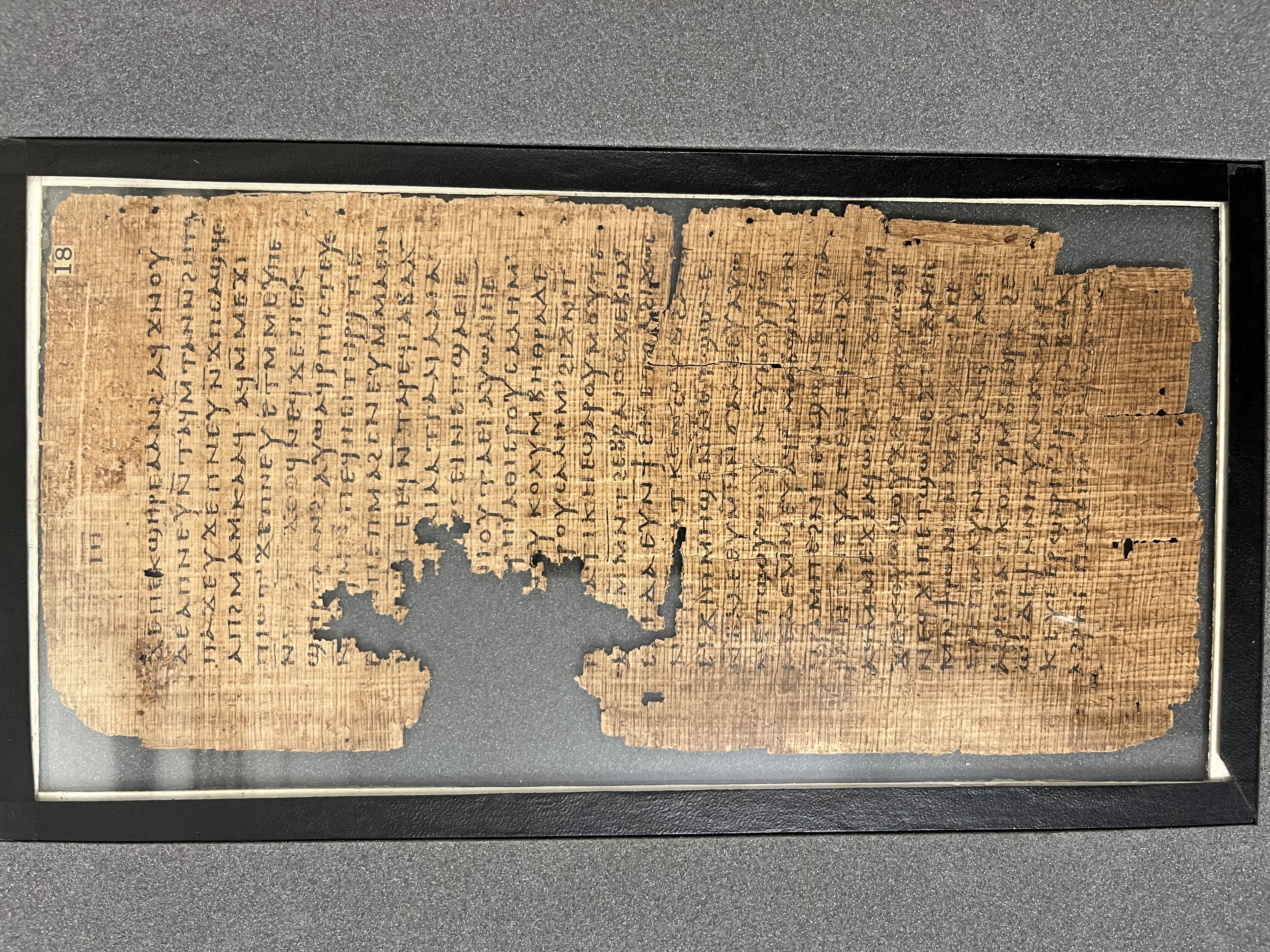
We also had the opportunity to examine the famous Qau Codex (Bible Society MS 137), a fourth-century papyrus manuscript of the Gospel of John in the Lycopolitan dialect—one of the most significant early witnesses to the translation of the Bible in Coptic.
Finally, the Genizah Collection at Cambridge, brought by Solomon Schechter from the Ben Ezra Synagogue in Cairo, contains a few Coptic fragments as well. Among these, there is an intriguing Bohairic Litany of the Cross (T.-S. K24.39), based on the sermon In Venerabilem Crucem attributed to John Chrysostom, which was widely circulated in Late Antiquity and the Middle Ages among both Eastern and Western Christians.

All in all, the trip proved to be fruitful. Nevertheless, much work remains to be done to fully identify the fragments and place them within their original codices. We look forward to sharing further updates as we continue to work through the materials we photographed during this trip.

A Visit to the Lucca Archive

In June of last year, our colleague, Alin Suciu brought a source of new Coptic papyrus fragments to the attention of our team.  These fragments, under the shelfmark Biblioteca Manoscritti 305 are housed in the Archivio di Stato di Lucca in Italy.

Of particular interest to me was a fairly large fragment from the book of Daniel, and it was with that main intent that I arranged a visit to the archive.

I visited the archive at the end of January and was able to consult the Daniel fragment.  An autopsy of the fragment enabled me to confirm Alin Suciu's identification of the fragment as coming from Daniel chapter 1.  This fragment forms an almost complete page from a codex.  This was a single column papyrus codex which would have measured not much more than 18 x 14.1 cm.  The margin is visible on one side of the page.  Specifically, the recto contains Dan 1:5b-8a and the verso 1:8b-10.

This attestation is of great help, as the only other witnesses of these verses in Sahidic are in sa 2050 and an ostracon (Var 18), which I am currently working on.  This is especially helpful with verse 7, which is entirely in a lacuna in sa 2050 except for the first word ⲁϥϯ.  Sa 2050 is housed in the Bibliothèque nationale in Paris and is only the bottom portion of a page.  At some point, it is likely there was more to the fragment, as Maspero has a great deal more text recorded for Daniel 1:7 in his Fragments de Manuscrits Coptes-Thébains[1]. With the addition of the text from Lucca, one can almost completely reconstruct this verse.  In addition, a second attestation to these verses serves to establish a complete reading for these verses - something that is exceedingly difficult with the biblical Daniel corpus in Sahidic, which is so fragmentary that many sections are not attested at all, or are attested only by a singular manuscript.

There were many other fragments that I was able to examine. I was able to confirm that despite being under one accession number, these fragments were written by multiple hands and come from multiple different manuscripts.  Some fragments are unimodular, while others are bimodular.   In addition, the size of the letters varied significantly between some fragments, and some were written with a finer pen than others.  The most likely explanation for the variation among these fragments is that they come from multiple manuscripts.

There were many other fragments that I wished to more closely analyze, but was unable to due to time constraints.  Time was short, but I hope in the future another trip can be made to complete the initial work on these fragments.

I look forward to continuing to work with this archive in the future and hope that a closer analysis of the many fragments will yield more Old Testament attestations.


[1] Maspero, G., “Fragments de manuscrits coptes-thébains provenant de la bibliothèque du Deir Amba- Shenoudah,” Mémoires publiés par les membres de la Mission Archéologique Française au Caire 6 (1892) 268.

Autopsying Manuscripts at the BnF in Paris, 18–23 November 2024

The research visit Diliana Atanassova and myself made to the BnF last week proved fruitful both in terms of autopsying original manuscripts and in terms of using different settings to decipher heavily damaged portions of texts. Diliana examined Sahidic liturgical fragments (ca. 10-11th c.) and Sahidic Old Testament leaves (from the 7th, 7th–8th and 11th c.). For my part, I examined Sahidic liturgical fragments and leaves (from the 10th to the 14th c.), an Arabic Holy Week lectionary (1312 AD) and the Latin Codex Colbertinus (12th c.).


In this brief blog post, I shall restrict my account to our experience with the UV light.

In recent times, the use of colour photography with enhanced resolution has often rendered the autopsy of the original material superfluous. However, this was not the case with the BnF images of the leaves and fragments under consideration, where parts of the texts were illegible. Our experience at the BnF last week showed that there are at least four different methods that can be employed in such cases.

The first is to work with the source material in the BnF's large dedicated reading room, which is lit by natural and artificial light. This can prove effective in enabling the deciphering of letters that have not undergone significant deterioration.

The second method is to examine the original in the above-mentioned reading room, while using UV light. One hand is used to cast a shadow on the text, while the other hand points the UV light at the text. This method proved effective in rendering some of the more challenging letters legible; however, there were places in which the ink was washed out and nothing could be seen while we were in the reading room.

It was evident that the only viable solution was to utilise a darkroom. We were very fortunate that Dr Vanessa Desclaux, the Curator of the manuscripts of Ancient Egypt and the Christian Near East, had reserved the Salon Rothschild for us and freed up time in her schedule to allow us to use this dimmable environment in her presence. There, we used the third method, which involved focusing on the illegible letters under UV light in total darkness. This proved an effective approach in many instances and enabled us to recognise the traces of the letters.

The fourth method was discovered by chance. A column of text had been so severely washed out that the ultraviolet light in the darkroom, shining on the missing text from above, had no effect. However, in an attempt to resolve this issue, Diliana discovered that the invisible text could be made visible by holding the ultraviolet light at a certain angle behind the page.

Our stay was evidently too short and we will definitely need to visit the BnF again. To conclude, we would like to express our sincere thanks to Dr Desclaux and to the competent and helpful staff of the Department of Manuscripts of the BnF.*

* The photos are published with the kind permission of the BnF. 


CoptOT Blog Entries